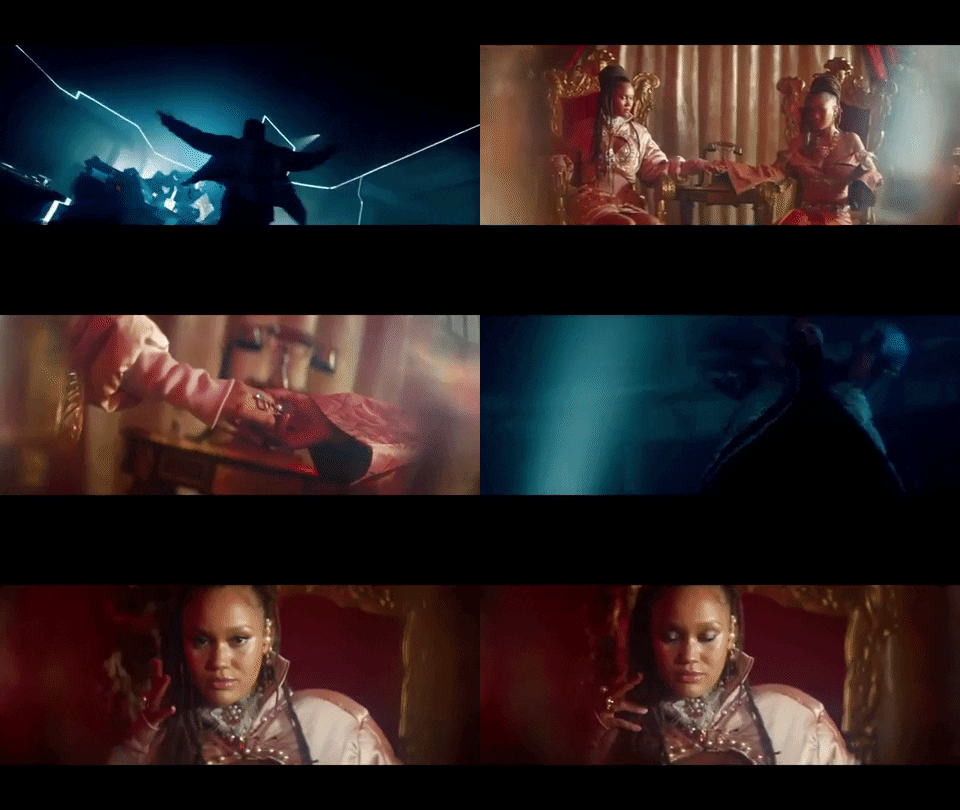
This image serves as a slight representation of what “Strange Fruit” entails.
Music is one of the most powerful tools. Click here to get a visual representation of how it does so.
All in all, artists have been utilizing the power of music to express how they perceive the world for years. Whether it was used as a way of evoking hope, happiness, or discontentment, it serves as one of the most instrumental outlets for a vast number of people.
In this case, the focus of music as an outlet is on protesting.
Defined as an objection or gesture of disapproval, artists have utilized their platforms to expose the horrors that they witness and experience. This allows for audiences of all backgrounds to be united under one commodity: that artist’s song.
I chose to make a timeline of protest songs and how they progress and reoccur over time because of the fact that history has been repeating itself, making songs from over 70 years ago just as relevant now as they once were.
Injustices still occur, racism still persists, and the “Strange Fruit” still hangs from metaphorical trees.
I hope that this timeline gives you a taste of the bitterness still seen today, from the Prelude to the Closing.
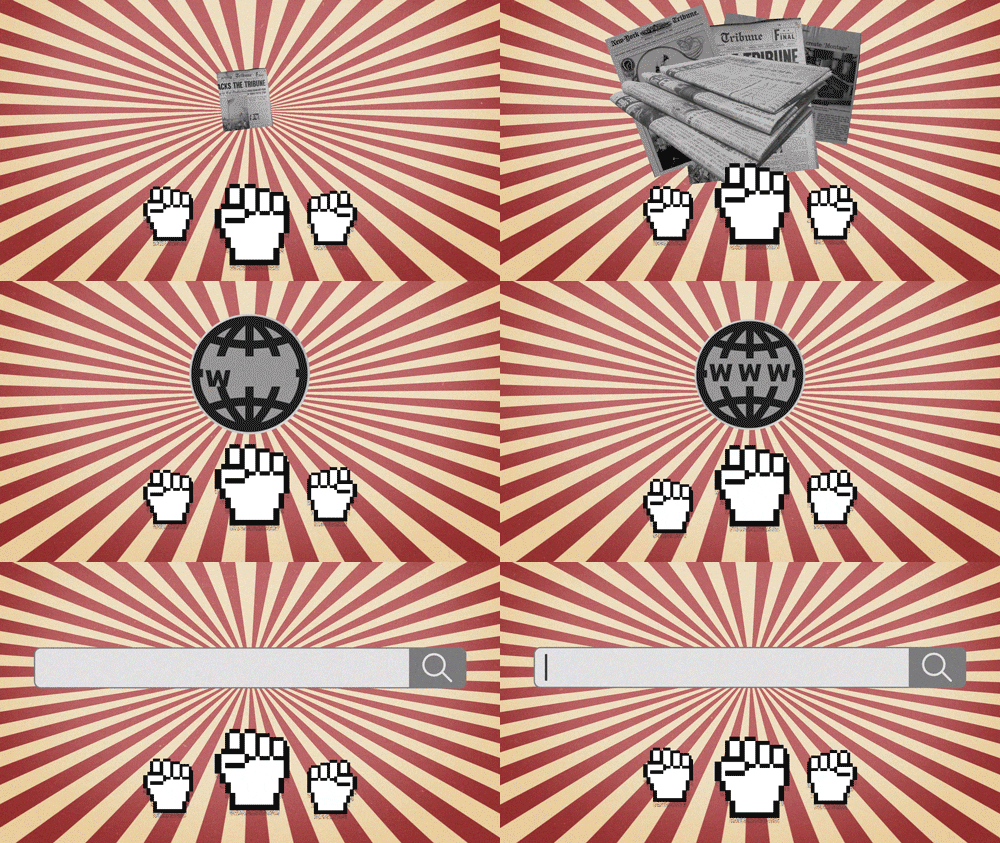
A visual representation of the various web browsers
For many people, it would seem as though the Internet has been around for a long time. For others, it has been around for their entire life.
But in the grand scheme of things, the Internet is a fairly new invention, and the world wide web developed as a result of it.
Defined as a vast network that links smaller computer networks worldwide, the Internet came from developments of the telegraph system and electricity. The web, on the other hand, is a virtual space of information.
As a response to the Soviet launch of Sputnik in 1957, the US military funded a project called the Advanced Research Project Agency Network, or ARPANET, and this served as the first true form of the Internet.
Since then, the Internet has not changed in the sense of its literal definition, but its purpose and uses by the masses have certainly underwent a shift. In its early days, the Internet was mostly used by scholars and scientists so that they could communicate with one another.
Not only does the public use it for much more miscellaneous reasons now, but contributors to its development have had interactions that were both controversial and warlike.
Explored through Vanity Fair’s article entitled, “How the Web was Won”, Keenan Mayo and Peter Newcomb interviewed an array of contributors to the web such as Robert “Bob” Taylor, the third director of ARPANET’s computer science division, and Marc Andreessen, the creator of Mosaic, the first web browser to truly “take off”.
But in terms of the significance of the Internet and the web as a whole, threats became more prevalent as the Internet became a more globalized system. The first attack in this “war” took place in 1988 in the form of the Morris Worm, which was created by Cornell graduate Robert Tappan Morris. He inadvertently shut down all network systems, and was later indicted under the Computer Fraud and Abuse Act.
Between attacks on actual network systems, and “beef” between competing browsers, the Internet and its influence have certainly expanded from being tools for scholars and scientists. Today, almost anyone can have access to the Internet, and they can use it for whatever they deem valid. Additionally, conflict between Internet and web-based corporations become more and more prevalent.
The evolution of the Internet has been an interesting one because of the fact that what started as a military project has allowed for me to even write about it on such a platform. As it continues to evolve, so will its uses and the influence of those behind the scenes.
Cory Utsey of “cutsey vlogs” gives her perspective on the Browser Wars and the Internet as a whole
This image is a still of Lacie Pound (Bryce Dallas Howard) from Black Mirror
Imagine a world in which every single action revolves around, or is dependent on what others think of you.
Realistically, this concept is not too far fetched. People act and have acted based upon the ideas of others for years, and in today’s day and age, the large presence of social media has a more heightened impact.
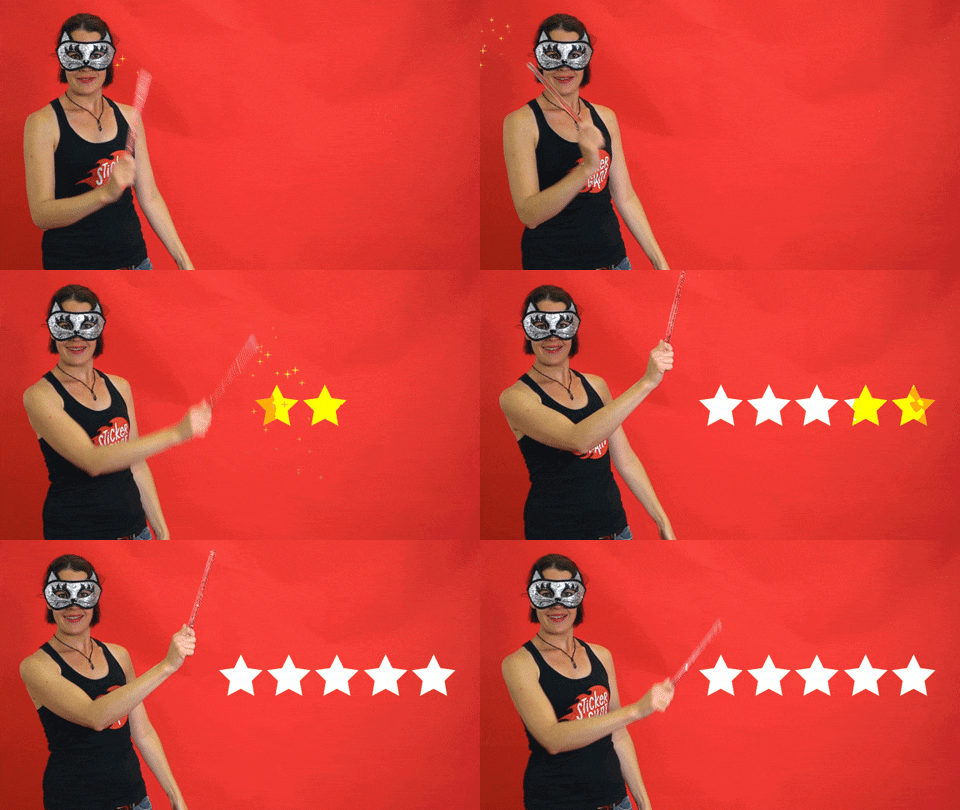
But in the case of Black Mirror’s “Nosedive” episode, this idea is applied within the context of a rating system that works within a social media-esque app. Not only was this episode executed well, but it says a lot about the direction that the world may head into if we allow ourselves to become too dependent on social media.
To sum it up without providing too many spoilers, “Nosedive” focuses on Lacie Pound (Bryce Dallas Howard) a seemingly average woman who gets invited to wedding with “high-ranking” attendees. Initially, nothing about her or her life seem to be out of the ordinary, but this changes as the episode progresses. We learn very quickly that in this world, almost everything is based on one’s social rating, which falls on a scale of one to five.
After any form of social interaction, those involved are able to rate one another, allowing for one’s score to go up or down. The further up it goes, the more respect one gains, and the more they are able to acquire. In Pound’s case, she learns that with a rating of 4.5, she can get a discount on the price of a new, appealing home and be able to better afford it, but she only has a 4.2. This dilemma, coupled with the opportunity to increase her rating at a wedding with these “quality people” ultimately lead to her demise.
Throughout the episode, it becomes clear that the harder she tries to increase her rating, the further it goes down. In this society, a higher social rating entails a higher socio-economic status, as well as a higher level of validation, and Pound seems to lust for these things.
Lacie Pound is an interesting character in the sense that almost all of her qualities are rooted in this rating system. In the beginning, all of her interactions, traits, and aesthetic are based in seeming more appealing to others, which would increase her scores. Even at the end, all of those qualities begin to juxtapose the rating system, as going against the standards of what should be considered as acceptable are thrown out of the window.
I enjoyed Pound as a character because of the fact that as the episode progressed, so did her outlook on society. Not only do we learn more about her genuine self by the end, but her genuine self presents itself loudly.
This is seen in one of my favorite scenes, which is where Pound recites a speech written and practiced at the beginning of the episode. When she is first seen practicing, it is clear that she is trying extremely hard to appease the “higher quality” audience at the wedding. She even goes as far as crying on command because in her eyes, it would have increased her appeal to those in attendance. However, by the end, she recites parts of this speech with a much more accurate representation of how she feels. Watching this scene was very powerful.
Besides the appeal of the episode’s concept, the actors did an amazing job at portraying each of their characters. But one thing that stuck out to me most was the use of colors throughout the episode.
I have always found colors and their meanings to be very interesting, and I loved the fact that pastel colors such as soft pinks and blues were used. Pink generally represents femininity, happiness, and approachability, and this color was frequently worn by Pound. By the end, though, her pink attire becomes dirty. This parallels the way in which she once tried to present herself in a happy, feminine and approachable so that those around her feel inclined to give a high rating, yet by the end, this ideal is tainted and abandoned.
“Nosedive” ultimately serves as a satirical commentary on the direction that society may be headed to if we allow ourselves to be consumed by social media and the validation of others. I enjoyed the way that this episode progressed, as Pound underwent a nice level of character development. At the same time, however, I believe that the representation of minorities, especially black characters, could have been much better. The few black characters in this episode were minor and portrayed as either elitist or desperate, and I did not see many other people of color.
While it is ironic that the basis of this review falls upon a rating system, just like the episode does, I would give “Nosedive” four out of five stars, and I believe that anyone would find this episode interesting to watch.
Social media can be a downward spiral or the way to to achieve higher, depending on how you see it.
Social media is an integral part of society.
Through apps and websites such as Facebook, Instagram, and Twitter, people of all ages and from all walks of life, are able to connect with one another through pictures and the circulation of stories. In terms of its intrapersonal effects, they tend to be dependent on the person. I do not believe that social media can create problems within these sectors. Rather, they heighten said problems. But when it comes to interpersonal interactions, the effects of social media tend to be more cut and dry.
While it is true that social media can have an impact on the way that one sees themselves, I believe that people give too much credit to these websites.
Self esteem is an issue that has always been prevalent in society. When there weren’t pictures to scroll through on Instagram, there were movies on television screens, people on magazine covers, and even crowds to walk through to cause one to invalidate their appearance or accomplishments. Social media has the power to bank upon these pre-existing issues, but it cannot inherently cause or create them unless the person is already dealing with them.
However, when concerned with relationships outside of oneself, social media can be a hit or miss. On one hand, it can be an outlet to communicate with other people who have common interests. Even if you do not have common interests, it is still possible to hear multiple perspectives and learn from them.
For me personally, I have found most of my interactions on social media to be refreshing– I have current friendships that were formed by way of the various apps.
At the same time, though, interactions on social media can be toxic. Because of the ability to say whatever is on one’s mind behind a screen, people tend to be much bolder on social media than they would in real life. This leads to hurtful comments that circulate and at times come from multiple people while being directed at a single person.
I believe that social media can be enlightening at times, but it is important to acknowledge that in many cases, people can be dehumanized. It is easy to forget that there is an actual person with emotions behind the Instagram or Twitter page. It is also easy to forget that social media captures single moments that are not indicative of a person’s entire existence–unless that person chooses to show every possible aspect of their life online, which is not very likely.
All in all, social media can be beneficial or detrimental to one’s interpersonal and intrapersonal relationships. But if we didn’t have social media as an outlet to feed into these interactions, it would likely be something else.
Three people comment on the ramifications of social media in their personal lives.
Though it is defined as a capacity for intelligent or rational thought, intellect can be expressed through various modes.
While it is true that levels of intellect, as well as “common knowledge”, have experienced a shift throughout the past fifty years, the idea that this current generation in the United States is the dumbest of them all is misguided.
Explored through Joel Best’s The Stupidity Epidemic: Worrying about Students, Schools, and America’s Future, the vast majority of the claims against the intelligence and critical thinking skills of Americans are based upon standards in other countries.
For example, when the Soviet Union launched its first artificial satellite, named Sputnik, in 1957, the American education system was labeled as a failure for not teaching math and science as effectively as the Russians did. Years later, in 2007, Tough Choices or Tough Times cited educational improvements in Asia. To be more specific, they mentioned China and India.
Best goes on to mention trends of a decline in education through the existence of television shows such as Are You Smarter Than A Fifth Grader?, as well as the public’s lack of knowledge over things considered to be common knowledge. In the year 2006, the Geographic Literacy Study, which was sponsored by the National Geographic Study, found that only two-thirds of adults were able to locate Louisiana on a map despite extreme coverage of the state due to Hurricane Katrina.
While these various factors are valid to consider, the idea that to be considered top tier, this country must be enthralled in “common knowledge” and STEM education- science, technology, engineering, and mathematics- is once again, relative. These subjects are of course vital to the development of a country, but the subjects of the arts are just as important, and there are many people that thrive throughout the spectrum of education. STEM subjects are not the sole factor in determining how intelligent and innovative a country is.
Plus, to be realistic, knowing where Iraq is on a map does not lessen or heighten one’s knowledge on what is actually happening there. A random person can easily point to California on a map and know absolutely nothing about the issues that were recently covered there.
And when it comes to the people that they are surveying for these studies, that in and of itself will always include some sort of unintentional, but present, bias. If you ask questions about things that Americans are expected to know on a random street, versus a college campus or a library, the percentage of people who know certain information may change.
Regardless of these things, the root of these education related issues is the American education system, and it needs to be fixed expeditiously. However, to be frank, I am tired of people critiquing the system but doing nothing to fix it. The trend in the system has been apparent for many years, and various people have kept note of it, but no one has done anything to actually fix it.
The argument that the current generation is the dumbest generation is not necessarily invalid, but it is based on studies that are given in concentrated areas, and comparisons with other countries that completely disregard the country’s strengths.
If we want to really talk about it, this country was already not making the best of choices when it comes to things such as war and Civil Rights– before the decline in education.
And if this country has a wound, we can’t fix it by simply talkingor writing about it. It must be treated.
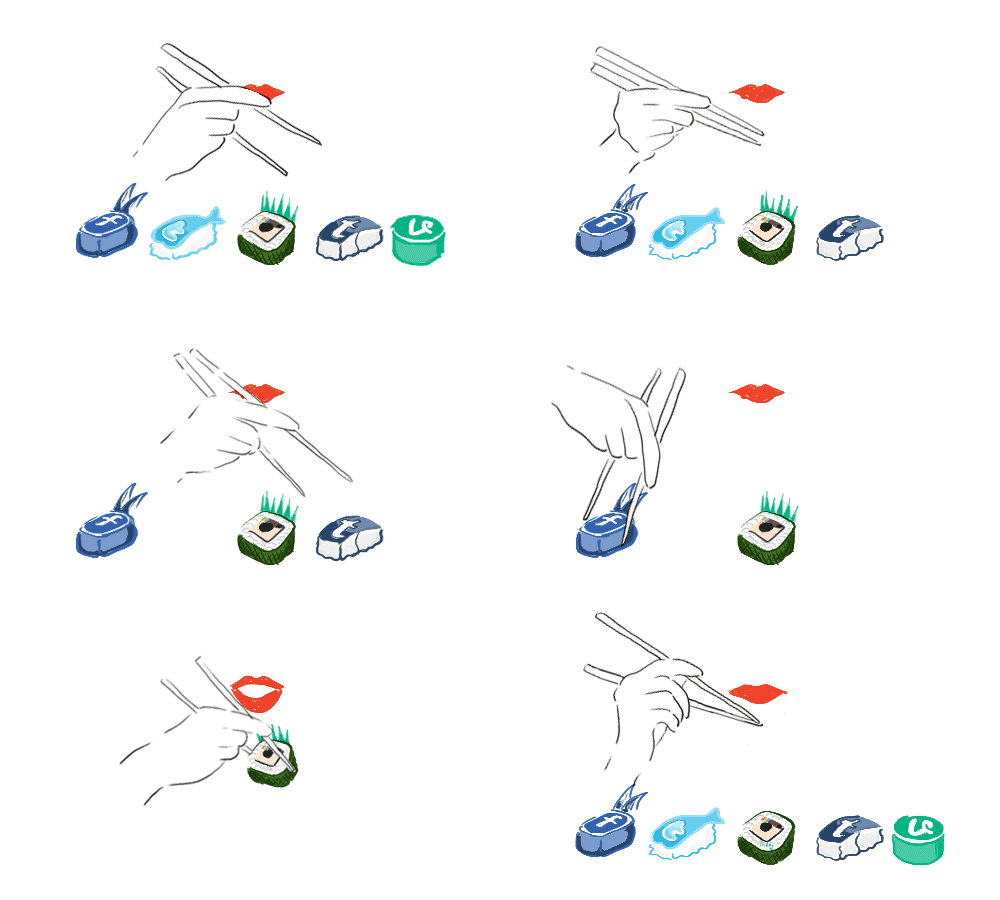
Phones stick to our hands in the same way that white sticks on rice.
Our attachment to these tiny rectangles is quite prevalent in society, as phones serve as the basis for many forms of entertainment and communication.
But that is the thing. Phones are a form of communication, and communication is vital in society. Therefore, so are phones.
Now I know.
My use of deductive reasoning might be viewed with raised eyebrows. The extreme use of phones holds a connotation that is very negative, but we must be realistic.
Phones are so common and necessary because the producers of these devices have made it hard for consumers to function without them. If we need to contact a loved one, we must use our phones. If we need to look information up, we use our phones. And when it comes to something that I frequently see as a college student: when we need some form of distraction from a heavy workload or an undesirable task, we use our phones.
We have been conditioned to be dependent on our phones to carry out everyday tasks, which is why it is so common to see people using them during everyday tasks. It is redundant, but it is true. This is why I choose not to pass judgment when I see people tapping away on their phones.
Feeling entitled to pass judgment because someone is constantly on their phone would be on the same wavelength as handing a baby some candy, and then getting upset because they chose to eat it.
In other words, if we have been forcefully given such access to these devices in order to function, we cannot be upset when people utilize them.
I concede to the fact that in social settings, excessive phone use can be rude, or plain unnecessary. However, it is still wrong to assume that in each instance, people are on their phones for miscellaneous tasks.
There have been various times in which I have seen someone on their phone as opposed to interacting with the people around them, but this may have been the case for many reasons.
Maybe the man in the striped shirt was on his phone because of a family emergency. And for the girl with her hair in a bun? Maybe her social meter just ran out and she lost the mental capacity to interact with those around her. As my peers and I frequently say, “It be like that sometimes”.
Keeping all of this in mind, I will continue to mind my business when I see people on their phones. Then, I will get on mine.
Through this Animoto, I further illustrate the relationship between people and their phones.
Selfies are of the most marketable products in today’s day and age. While many individuals take these pictures with the purpose of capturing their face in that moment, there is a science behind that simple action. Selfies can be indicative of much more in society, including those who hold some level of power, and the people actually taking them.
To start, a selfie is defined as a self-portrait picture, typically taken on a handheld digital camera. They are taken in a flattering position, and are perceived to be causal by the people viewing it. After taken, these portraits are generally shared on social media platforms.
Within recent years, platforms such as Instagram, Twitter, and Facebook have seen a surge in this user-generated content, as many non-professional individuals have become much more engaged with media and media platforms.
However, many individuals are now able to profit off of their selfies by means of brand partnerships. While these pictures may appear to be casual, everything about them tend to be intentional– the angle, the lighting, the face, the placement of every hair on their head, and much more.
Whether it be an advertisement for an app that can “beautify” one’s face, or the release of a phone with a new and improved camera, brands have found a breeding ground to play off of the common individual’s insecurities.
This is possible because of the science behind selfies. Realistically, no one has ever seen how they actually “look” in real life. Everyone has seen pictures of themselves, reflections in mirrors, and felt how their face moves, but this is not the same as seeing their actual face. Due to this lack of visual knowledge, it becomes easy for brands to make their move; it is not difficult to make an appeal over something that the consumer hasn’t actually “seen”.
While it is true that selfies have the marketability of a physical product, this is more of a result of capital greed, and less because of the actual selfie taker. People take and post selfies for a variety of reasons, whether it be to document a moment in which they feel they look good, or to gain some sense of validation from those who interact with their content.
In other cases, they take them for the sole purpose of gaining revenue. But regardless of one’s intentions, it is easy to find room to make profit in a society where individuals are conditioned to believe that they are not good enough. If a person who already believes that they are not beautiful enough sees a brand advertising some product (by way of a selfie) that makes them “more beautiful”, they may feel an inclination to buy that product.
Selfies are simply another tool for those in control. To put it simply, if it were not selfies being used by these businesses to make money, it would be something else.
Selfies have certainly been used among various strategies to aid in manipulating the masses, but they are not always used in these ways. In some cases, selfies are simply a way of assessing how one looks, and choosing to either share it with the world or keep it to one’s self. They are able to fulfill things such as control and a meaningful existence, but this is not always negative. The problem with selfies is not the action of taking one, but is instead what comes after.
Questions such as these become relevant in a “post-selfie” evaluation: Who has access to it? What can they use the picture for? Why are they using it? Who benefits from this release of the photo?
Regardless of the possibilities, people will continue to take these pictures for fun and for the sake of making money. But as long as people are aware of how this content can be used to influence their decisions, it will not have the same affect.
All in all, the rise of the selfie has had an impact on the way that people navigate social media, and it will continue to have an impact as long as social media platforms exist. But as some things evolve, other things devolve, and selfies are not exempt from this inevitability.
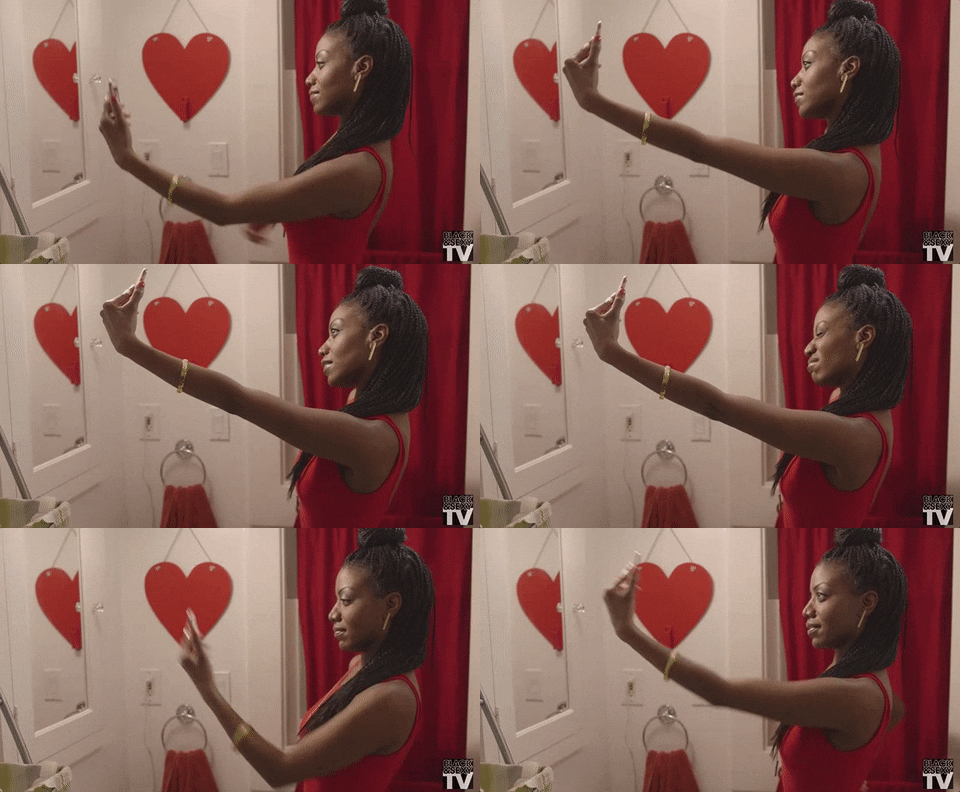
It took time for me to realize that selfie taking is an art.
The first selfie that I ever took is somewhere deep in my middle school Dropbox account, and for the sake of pride, I will not be logging back into that account to look for it.
I am almost positive that any selfie of me from six years ago would make me cringe. Whenever someone says, “If looks could kill, [you] would be dead right now,” they are typically referring to some smoldering twinkle in the eye of someone who is upset.
Yet, when I say it within this context, I am honestly just referring to how I looked. If the looks that I had in selfies from six years ago could kill…I digress.
While my selfies have certain requirements that the old me would have failed miserably, I believe that like any art, the typical standards are relative. What qualifies as a good selfie, or a post-worthy selfie, changes with every person, and they also evolve over time.
For the me from six years ago, the perfect selfie is taken with both hands extended and fully visible within the picture. If I’m not smiling, my eyes must be opened as wide as possible–like an “I’m so surprised!” look, but “cuter”. And in terms of faces? A nice set of duck lips would suffice.
However, whenever I take selfies now, I tend to focus on the more technical things. I hate taking selfies from an angle that is too upward, my hair cannot be cropped awkwardly, and if the natural lighting washes me out, I absolutely have to edit it.
I wouldn’t call it an obsession, but I do find the art of taking the perfect selfie to be very interesting, as many people have technicalities more intense than mine. I’ve even watched videos on it before.
Beauty influencer and YouTuber Alissa Ashley breaks down the process to taking quality pictures on an iPhone.
Quite honestly, it’s crazy to think about selfies and how they have evolved as a whole. But when it comes to their meaning for me specifically, I’m not sure that it really has one.
I like for my selfies to look good by my own standards, but I don’t care about them as much as it may seem from my process. I really enjoy taking pictures and editing them to play with things such as lighting and exposure, so I transfer that into selfie taking. But realistically, it’s just something that I enjoy doing. I take them for my own “self pleasure”.
I do think that because of social media, the importance of selfies has been heightened. In extreme cases, they can make or break a career, and they also serve as a good way of incorporating representation into everything.
Overall, selfie taking is an art, but I am no expert artist. So to those who are, or consider themselves to be expert artists, continue thriving.
“Gotta hit them angles”, right?
In this vlog, I speak on selfies and what they mean to me.
Things really do come full circle. During some time between January and April- I would specify, but I really have no sense of time- my sister Courtney and I were talking about college and my career. By this time, I had pretty much solidified that I would be attending the illustrious Howard University, and that I would be a Media, Journalism, and Film major with a focus in Journalism. She suggested that I start some type of website or blog to both utilize my writing skills, and to start setting myself up for my career. Being that I trust her judgment, I considered it. I even began drafting a website and set up a color scheme of teal, orange, and purple.
But that was as far as I got.
I abandoned that idea as I tend to do with various things– it just depends on what I happen to prioritize at that time. And here I am (however many) months later, starting a blog. It may be for a grade, but I am well aware of the way in which this can help in the future.
And I am all the way here for it.
Nevertheless, I believe that blogging can be a useful medium for information and the varying perspectives on it in today’s day and age. According to Mark Briggs’ “How to Blog” in Journalism 2.0, blogging is defined as being an online journal that is frequently updated and written in a more informal and conversational way.
I believe that this can be a convenient way of receiving and analyzing information because, frankly, people aren’t as receptive to traditional news as they once were. If you’re over the age of thirty-five, the idea of sitting down and actually watching the news may not seem very repulsive, but for me at least, I have other things I could be doing. There are various ways in which I can receive information. Briggs stresses the fact that by building a bridge with your audience, and utilizing credible sources to back your assertions up, you can keep an audience and create a sense of unity.
In addition to maintaining a good flow of information, other factors can contribute to building an audience and keeping it. Briggs states that frequent posting, attribution, and combining personality with authority can be vital- I believe that personality plays a large part. Poor style, and a poor attitude as it is portrayed through writing, can be just as much of a deterrent as bad information. Each of these things must work together in “harmony” to have a successful blog.
All in all, this whole blogging (and vlogging) thing will definitely be an adjustment, and I kind of have to do it, but I’m excited to see where this goes.
And in terms of vlogging? That’s a whole other process. But if you’d like to see my first ever vlog, scroll down just a bit (and don’t judge me too hard).
In this vlog, I express my opinion on vlogging, as well as the things that I have enjoyed in my Digital Media Literacy Class.

















 cutsey blogs